Welcome to the

eBooks by

Award Winning Author

Mathis B. Rogers

Blog

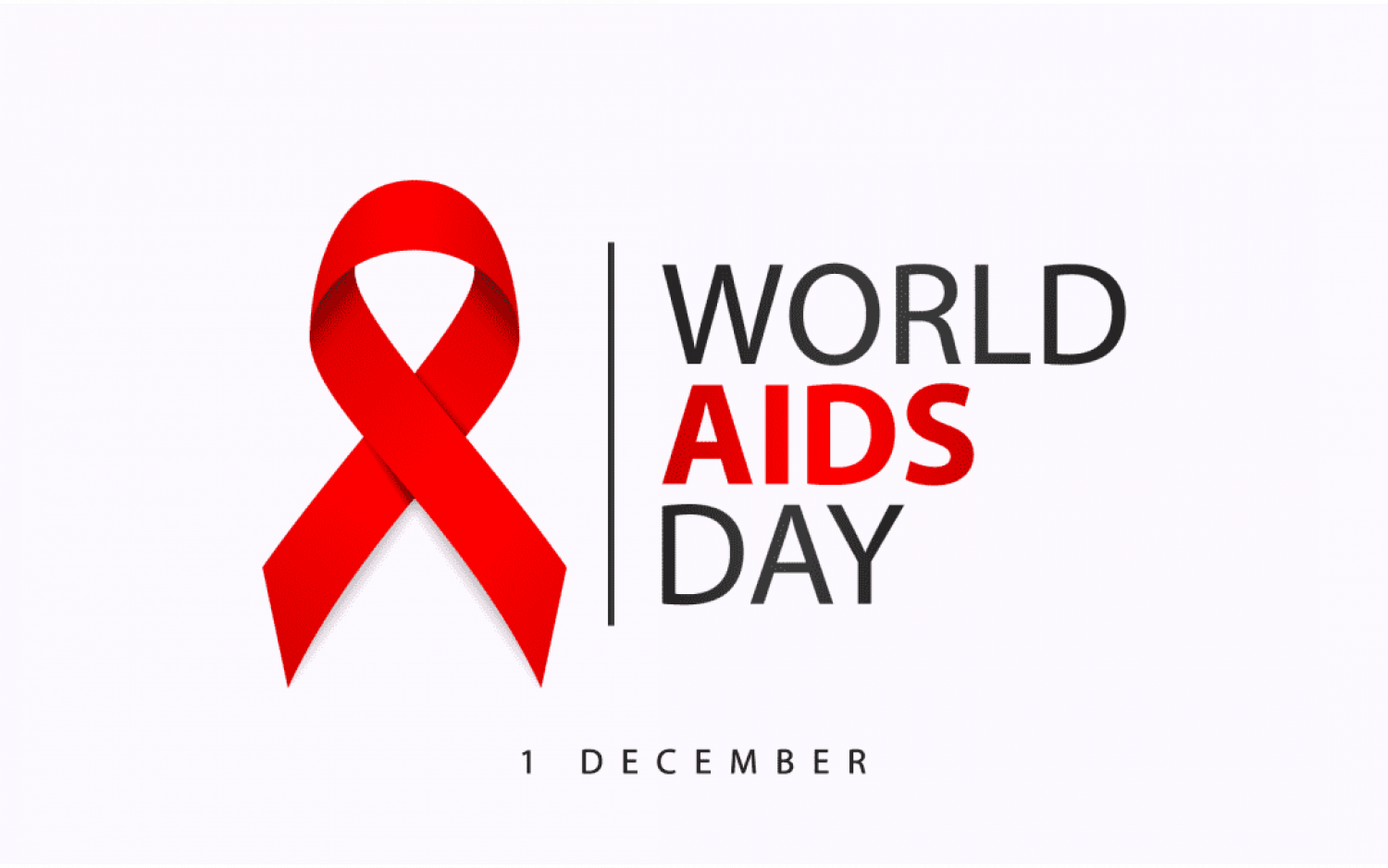
Happy World Aids Day

World AIDS Day, observed on December 1 each year, is an opportunity to raise awareness about HIV/AIDS, honor those who have passed away from the disease, and support those living with HIV. Established in 1988 by the World Health Organization (WHO), it serves as a reminder of the ongoing global battle against the virus. The day is marked by events, educational campaigns, and initiatives to promote prevention, testing, and treatment. While significant progress has been made in the fight against HIV/AIDS, the ultimate goal remains to end the stigma, ensure universal access to healthcare, and ultimately find a cure.

Generated by AI

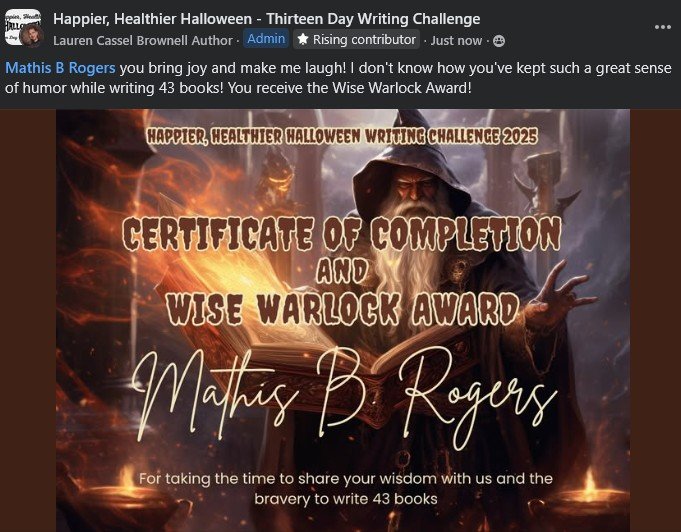
Wise Warlock Award

My friend and fellow author, Lauren Cassel Brownell, created the Thirteen Day Writing Challenge from October 19, 2025 through October 31, 2025.

She said: 

“Mathis B Rogers you bring joy and make me laugh! I don’t know how you’ve kept such a great sense of humor while writing 43 books! You receive the Wise Warlock Award!”

Although I wasn’t working on anything for Halloween, I spent my time editing Hot-Rod Magazine.

 So excited to add one more award to my list.

October 14, 2025 is the 31st Anniversary of Kris & Brad.

Shipwrecked

Kristopher Brown and Bradley Peterson experience the not-so easy life of a young gay couple living in the Pacific Northwest.

Happy Fall, Ya'll!

We Must Never Forget:
9/11/2001 Tribute

The Tragic Events of September 11, 2001: A Defining Day in History

September 11, 2001 (9/11) remains one of the most significant and tragic events in modern history, marking a pivotal moment for the United States and the world. On that day, a series of coordinated terrorist attacks orchestrated by the extremist group al-Qaeda changed the global landscape, claiming the lives of nearly 3,000 people and shaking the foundations of security, politics, and international relations.

The Attacks

The attacks began at 8:46 AM when American Airlines Flight 11 crashed into the North Tower of the World Trade Center in New York City. Seventeen minutes later, United Airlines Flight 175 struck the South Tower. Both skyscrapers, towering symbols of America’s economic power, were set ablaze and ultimately collapsed within hours, sending plumes of dust and debris into the streets of lower Manhattan.

At 9:37 AM, American Airlines Flight 77 crashed into the Pentagon in Arlington, Virginia, severely damaging the headquarters of the United States Department of Defense. Meanwhile, the passengers and crew of United Airlines Flight 93, having learned of the earlier attacks through phone calls, heroically attempted to regain control of their hijacked plane. Their actions prevented the plane from reaching its intended target, likely the White House or the U.S. Capitol, but resulted in a crash in a field near Shanksville, Pennsylvania, killing all 44 people on board.

The Human Toll

The death toll from the attacks was staggering. In addition to the passengers on the four planes, 2,753 people were killed in New York, 184 at the Pentagon, and 40 in Pennsylvania. Thousands of first responders rushed to the scene in New York, and hundreds of them—firefighters, police officers, and paramedics—lost their lives trying to save others. In the aftermath, many more would suffer from injuries and long-term health effects due to exposure to toxic dust and chemicals at Ground Zero.

Immediate Impact

The immediate reaction to the attacks was one of shock, grief, and anger. Across the U.S., citizens were glued to their televisions, witnessing the horrific images of the towers collapsing, the Pentagon burning, and the haunting silence of Flight 93’s crash site. New York City was transformed into a war zone as rescue efforts continued around the clock.

Air travel across the country was grounded for the first time in history, and emergency measures were enacted to secure critical infrastructure. President George W. Bush, who was in Florida at the time of the attacks, addressed the nation later that evening, condemning the “acts of terror” and promising a robust response. He declared that America would pursue those responsible and bring them to justice.

Global Aftermath and Response

Within days of the attacks, U.S. officials identified Osama bin Laden, the leader of al-Qaeda, as the mastermind behind the plot. Al-Qaeda, a militant Islamist organization based in Afghanistan, had long harbored anti-American sentiments, and its operatives had spent years planning and training for the 9/11 operation.

The U.S. government, with the support of NATO and allies around the world, launched the War on Terror. This included the invasion of Afghanistan in October 2001 to dismantle the Taliban regime, which had been providing shelter to al-Qaeda. The conflict in Afghanistan would become the longest war in U.S. history, lasting until 2021.

In response to the attacks, Congress passed sweeping security legislation, including the USA PATRIOT Act, which expanded government surveillance capabilities and intelligence sharing. The Department of Homeland Security was established in 2002 to coordinate national security efforts. Air travel security was dramatically overhauled, with the creation of the Transportation Security Administration (TSA) and stricter screening processes for passengers and cargo.

The Long-Term Legacy

The legacy of 9/11 is multifaceted, touching every aspect of global politics, security, and societal awareness. In the years following the attacks, the U.S. became involved in complex and prolonged military engagements not only in Afghanistan but also in Iraq, which was invaded in 2003 under the pretext of disarming weapons of mass destruction (WMDs). Although the Iraq War was not directly tied to 9/11, it was justified as part of the broader War on Terror.

The consequences of 9/11 are also seen in how governments approach terrorism today. The expansion of intelligence agencies, anti-terrorism measures, and new international coalitions against extremist organizations have become commonplace. Moreover, the attacks dramatically reshaped U.S. foreign policy, particularly in the Middle East, and have influenced global geopolitics for decades.

Memorializing 9/11

Every year on September 11, the U.S. and the world pause to remember the lives lost in the attacks. The National September 11 Memorial & Museum was opened in New York City at Ground Zero, serving as a tribute to the victims and a place of reflection. Twin reflecting pools now stand where the World Trade Center towers once stood, inscribed with the names of those who perished.

For many, 9/11 remains not only a day of tragedy but also a reminder of resilience, unity, and the importance of vigilance in the face of threats to security and freedom. The event reshaped how nations prepare for and respond to terrorist threats, and it forever changed the collective consciousness of those who lived through that fateful day.

Conclusion

The events of September 11, 2001, had a profound and lasting impact on the world. It was a day of immense loss and heroism, as ordinary citizens, first responders, and political leaders came together in the face of an unimaginable tragedy. Though the physical scars of the attacks have been repaired, the emotional and political reverberations continue to shape global dynamics to this day.


Generated by AI

Labor Day in the United States is a federal holiday celebrated on the first Monday in September. It honors the contributions and achievements of American workers and the labor movement, which advocated for fair wages, reasonable hours, and safer working conditions. The holiday was first celebrated on September 5, 1882, in New York City, organized by the Central Labor Union.

Labor Day became a federal holiday in 1894, following the Pullman Strike—a nationwide railroad strike that turned violent—and President Grover Cleveland’s efforts to reconcile with the labor movement. The day is often marked by parades, picnics, barbecues, and other community events. It also symbolizes the unofficial end of summer, with many schools and businesses starting their fall schedules after the holiday.

Labor Day weekend is a popular time for travel, and the holiday is associated with retail sales, especially back-to-school promotions. While its origins are deeply rooted in the labor movement, today, Labor Day is also a time for leisure and relaxation, with many people enjoying the extended weekend.


Generated by AI

As you know, I have my eBooks at both Amazon for Kindle editions and Smashwords for all eReader formats. 

Each year during July, Smashwords has a “July Summer/Winter Book Sale” where authors can list their eBooks at a discounted price, or just to add them to the promotion to sell them at regular price, if they prefer.

I have added all of my “Adult” eBooks to the list for 1/2 price—except for the ones I have already listed at .99.  Those are Free.

I have also  published an “Author Interview” under my Profile, and you can check it out here.

If you haven’t managed to pick up all of my eBooks yet, this is a good opportunity for you to get them.

You can either go to my Stories  > Adult Stories link, or just go directly (never go straight) to my Smashwords Profile here to see the list and get them there.

Again, this sale is only on Smashwords, so you won’t be able to get eBooks for a discount anywhere else.

Also, I will be releasing Hot-Rod Magazine,  soon, but not in time for this sale. So be sure to visit my Contact Page and sign up for my notification list, so you’ll receive an email when I release it and any other books.

Happy Reading,

Mathis…

PS: If you’re curious as to why Smashwords calls it “Summer/Winter” when it’s only for the month of July, they are world-wide and some places are actually having winter right now.

Juneteenth: A Celebration of Freedom and Resilience

Juneteenth, observed on June 19, marks a pivotal moment in American history—the day in 1865 when enslaved Black Americans in Galveston, Texas, finally learned of their freedom, more than two years after the Emancipation Proclamation was signed.

The History Behind Juneteenth

On January 1, 1863, President Abraham Lincoln issued the Emancipation Proclamation, declaring enslaved people in Confederate states free. However, due to the ongoing Civil War and resistance from slaveholders, many enslaved individuals remained unaware of their freedom. It wasn’t until June 19, 1865, when Union General Gordon Granger arrived in Galveston with 2,000 troops and issued General Order No. 3, that the last enslaved people in Texas were officially freed.

The Evolution of Juneteenth Celebrations

The first Juneteenth celebrations began in 1866, with prayer gatherings, feasts, and community events. Over time, the holiday spread beyond Texas as Black families migrated across the country. In 1980, Texas became the first state to recognize Juneteenth as an official holiday, and in 2021, it was designated as a federal holiday.

How Juneteenth is Celebrated Today

Juneteenth is a time for reflection, education, and celebration. Communities across the U.S. honor the day with parades, festivals, concerts, and historical exhibits. Traditional foods like barbecue, red velvet cake, and hibiscus tea symbolize resilience and joy. Many also use the day to discuss Black history, achievements, and ongoing struggles for racial justice.

Juneteenth in Lubbock, Texas

In Lubbock, Juneteenth is celebrated with a week-long series of events, including a parade, gospel night, game nights, and fireworks. The city’s festivities bring together people of all backgrounds to honor the legacy of freedom and unity.

Why Juneteenth Matters

Juneteenth is more than just a holiday—it’s a reminder of the resilience, strength, and contributions of Black Americans. It encourages education, reflection, and action to ensure that freedom and equality are upheld for all.

As we celebrate Juneteenth, let’s take time to learn, uplift, and honor the sacrifices and triumphs that have shaped our nation.

Stay Safe

Sign up now so you won't miss my next book!

X
Scroll to Top